
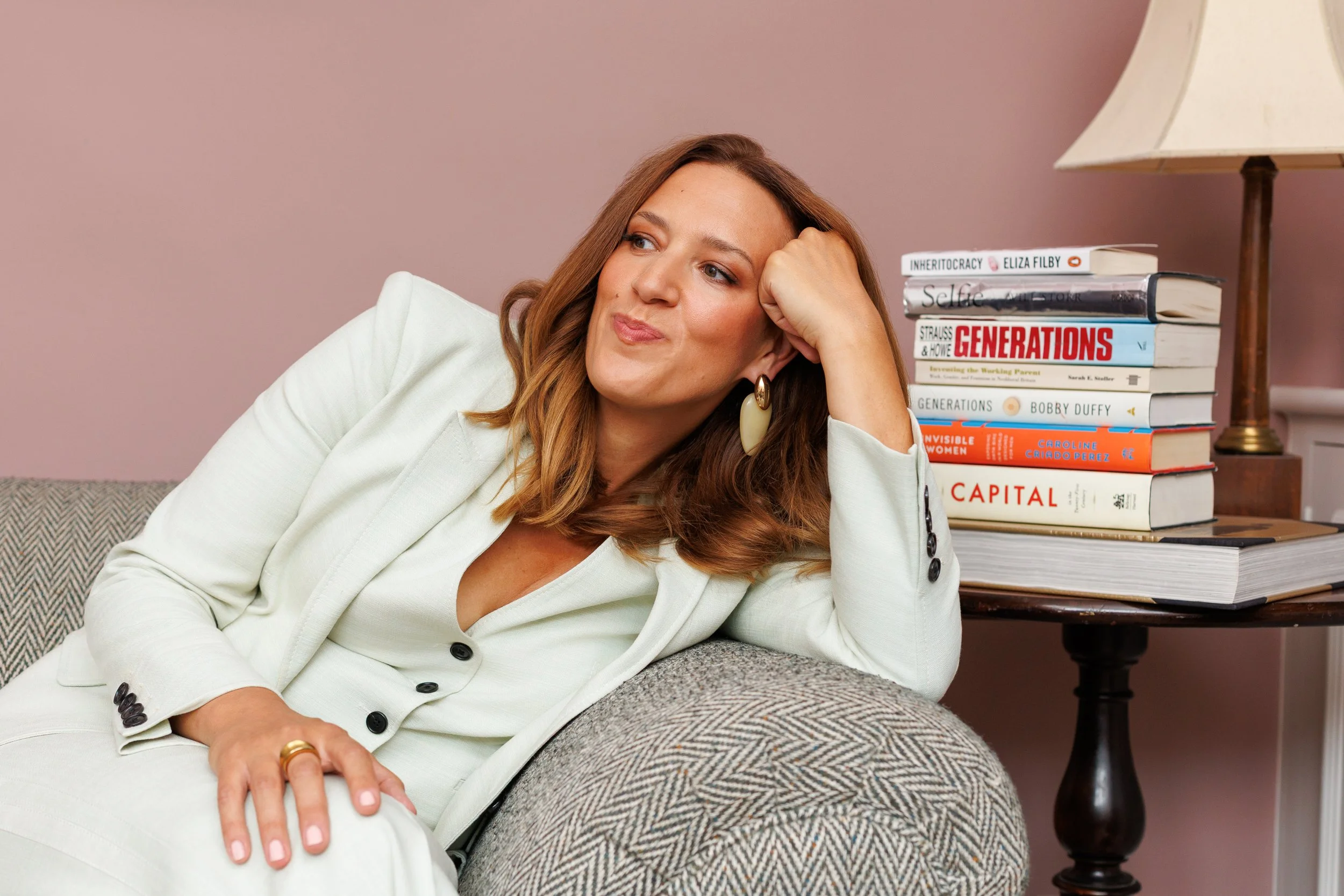
A Little About Me
I'm Dr Eliza Filby. I'm a historian of the present, which is totally a self-appointed title I made up for myself but it works! Because it describes what I do; it means I spend my time trying to understand why the world looks the way it does, how we got here and what might be coming next.
I had ten years in academia as a historian, and have now spent ten years working in business as an adviser and speaker, helping senior leaders across international business and governments understand trends and change. I've worked with organisations ranging from Cisco to PwC, HSBC to McDonald's. A very wide range of people, sectors, doing different stuff.
I'm also a bestselling author, speaker, founder, Times columnist, Non-Exec Director and, increasingly, a YouTuber. Not quite the career trajectory I imagined when I started my history PhD at Warwick. I'm a proud multi-hyphenate, who moves between the worlds of academia, media and business.
Why generations?
We know that the generations are generalisations, but forget the brackets. Forgive me I slightly roll my eyes when I hear someone say they don’t believe in generational categories. Yes, they are limited, but so is gender as a category of analysis. Fundamentally, they are a key way of understanding and conceptualising change; they are also the unit of time that defines the family... and I'm obsessed with the evolution of family.
For me, generations have never really been about labels or whether Boomers are selfish or Gen Z are entitled. It's about understanding how the world changes between one generation and the next, and how those changes affect our opportunities, expectations and relationships.
I also have two children. I'm rather obsessed with what on earth my own kids will be doing when they grow up, how they will live, grow up, work and what the world will look like for them.
How did you end up doing this?
I was the first one in my family to get a degree and I think that's why I went to university and basically never left. I did my PhD in contemporary history at the University of Warwick and went on to teach at King's College London and Renmin University in Beijing.
I've always loved research and big trends. I grew up in a very shouty, argumentative household, where ideas were debated and challenged…. I knew I wanted to take the ideas beyond universities and into the places where decisions are being made but also communicate them in a way that would have broad appeal.
Over time, that meant working with businesses, speaking at conferences, writing books and eventually founding my own company, All Relative, to give a proper home for our ideas and our programmes.
Last year, I found myself lecturing at Harvard Law School talking to the future of the legal profession and a few weeks later being interviewed on the Trevor Noah podcast about my book Inheritocracy... and honestly, I thought that is exactly the kind of breadth of experiences I want to have in my career.
I have an unconventional path, but I think that's rather the point. Increasingly, the most interesting ideas don't sit neatly within one discipline, industry or institution.
You've written three books. What's the latest one about?
My latest is Inheritocracy: It's Time to Talk About the Bank of Mum and Dad, which became a Sunday Times bestseller. It's about something I think we're still struggling to admit: that family wealth is playing an increasingly important role in determining people's opportunities. That’s why the book starts with my own story around the Bank of Mum and Dad.
I also wanted to explain to people the broken path we were sold. We've spent decades telling people that if they work hard, get an education and make sensible choices, they'll get ahead. But increasingly, the circumstances you're born into and the financial help you receive from your family have an enormous influence on the life you can build. I tell the British story, but there are multiple forms of this story happening across the world.
The book is about money, certainly. But it's also about relationships, family obligations, independence, inequality and the changing meaning of adulthood.
I'm currently writing a book about the collapse of the career ladder and what is coming next. It's out in 2027.
In many ways, the two books are connected. One is about how the old rules of getting ahead financially have changed. The other is about what happens when the old rules of getting ahead professionally no longer apply.
My substack and books are rooted in the kind of writing I like doing: big on personal anecdote, broad observation, data and interviewing others whose lives are very different to mine.
Let me tell you, I'm largely driven by a personal quest to understand my own life better, and I feel a need to share that if I possibly can with data, debate and humour!
And what do you actually do with businesses?
I founded All Relative to basically answer two fundamental questions that businesses are asking right now.
What is the future of multigenerational work in the age of AI?
We answer that with The Generational Blueprint™. It helps organisations understand the tensions between generations, rethink how they recruit and retain younger and older workers, and build better ways of working together in an age when AI is frankly revealing the sorry state that work has been in for the last twenty years. We’ve worked with everyone from the British Civil Service to major US law firms on this.
And what is the future of wealth in the age of the Inheritocracy?
We answer that with Trust Transfer. Because forget the Great Wealth Transfer, what is transferring isn't actually just wealth, it's trust. Trust between generations, between families and their advisers, and between financial institutions and the people who will increasingly control tomorrow's wealth.
We’ve worked with organisations from PwC, LGT to Julius Baer and HSBC, helping them understand the changing relationship between generations, work and wealth.
What I also love about this work is that the questions might be enormous, but I believe the solutions often begin with very human things: how people communicate, how they learn from one another and whether they understand or are ignorant of the lives and circumstances of the people around them. Quite a lot of misunderstanding in work and in families comes down to this!
How did the It's All Relative show and newsletter come about?
Everything that is being talked about in boardrooms are also being talked about around kitchen tables and family WhatsApp groups. I could see that in the finance world for sure. What was called the Great Wealth Transfer; was known as the Bank of Mum and Dad in families. So I wrote a book about it and connected the dots.
And I want to do that more and more, take the conversations I was having in boardrooms and bring them into everyday life.
That's why I created It's All Relative. I want to help people realise that what they often see as a personal failure - failure to get on the housing ladder, reach adult milestone, flexible career - actually has structural reasons. The things we often think of as individual successes, failures or anxieties are frequently the consequences of much bigger economic, social and cultural changes and knowing about them can be incredibly empowering, and that applies, whether you are a business or an individual.
I started on Substack before it was fashionable back in 2021, I then spent some time doing some weird, unsuccessful TikTokking, and then in 2026, we launched the YouTube show, an art form I am still very much learning.
The idea is simple: your life, in context.
I take what's happening in the world and connect it to the lives we're actually living. Sometimes that means looking at why two incomes no longer seem enough. Sometimes it's the economics of choosing not to have children, the collapse of the career ladder or what retirement will look like for the next generation.
The project was selected for Goalhanger's inaugural Accelerator Programme in 2026, and there’s some exciting things planned for the future.
Ultimately, I want It's All Relative to be somewhere people come not just to understand what's happening in the world, but to understand their own lives a little better. And stop the self-blame game!
And when you're not writing books or making videos?
I'm usually talking. Or writing. Or talking about something I'm writing. I write a fortnightly money column for The Times and a monthly column for City A.M. My writing has also appeared in the Financial Times, The Guardian and The Spectator.
I've appeared on the BBC, Bloomberg and NBC, as well as podcasts including Amol Rajan's Radical and Prof G with Scott Galloway.
What's the thread connecting all of this?
I suppose I'm interested in this idea if we agree that we are living in a period of profound change, can we not just fixate on the technological shifts, because there are major developments happening in gender relations, families, wealth generation. So I’m interested in identifying that change; the gap between the lives we were told to expect and the lives we're actually living.
We inherited a set of assumptions about work, wealth, family and ageing that made sense in a particular moment in history. Many of them no longer fit. And yet we're still using them to organise our careers, our finances, our businesses and our expectations of one another.
Whether I'm writing, speaking, researching or making videos, I'm trying to understand that gap.
For Press and Event Organisers
Looking for an official biography, speaker introduction or press photographs? Everything you need is here.
Biographies (.docx download)
Photos (zip download)